Scalability
Learn why systems break under load, how horizontal and vertical scaling work, and how to design for 10x traffic without a 3 a.m. outage.
TL;DR
- Scalability is a system's ability to handle growing load by adding resources, without redesigning from scratch.
- The two core levers are vertical scaling (bigger machines) and horizontal scaling (more machines). Horizontal scaling is often a better long-term fit for stateless services, but it is not automatically the right answer for every component.
- Stateless services make horizontal scaling much easier. Sessions can live in an external store such as Redis instead of in one process's memory.
- A database is often an early bottleneck, but measure whether the pressure is reads, writes, queries, storage, or connections before choosing replicas or sharding.
- The fundamental trade-off: every layer you add multiplies your capacity but also multiplies your failure surface.
The Problem It Solves
Your app is fine at 1,000 users. Then your product gets posted on Hacker News at 9 a.m. on a Tuesday. By 9:05, you have 50,000 concurrent users.
The single server's CPU pegs at 100%. The request queue fills up. New connections get refused, users see spinning loaders, and your on-call phone rings.
And the worst part? The server isn't broken. It's doing exactly what you built it to do. You just built one of it.
The scaling blindspot
Some outages are caused not by a new bug, but by an architecture that has reached the limits of the load it was designed to handle. A system that worked at 10,000 users may need a different capacity plan at 100,000.
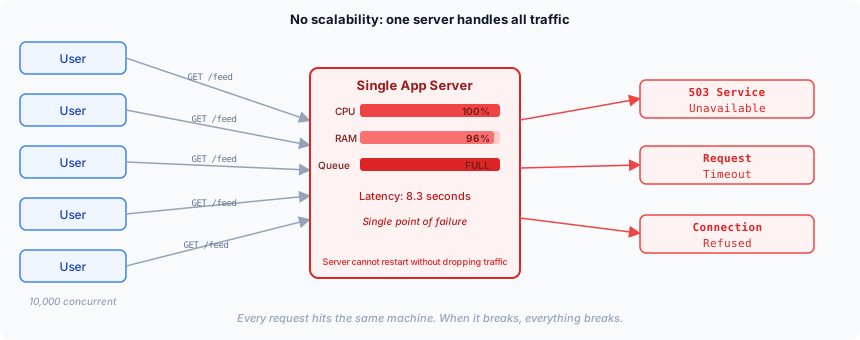
Scalability is the discipline of designing systems so that this limit is understood and can be extended safely. It is easier to make that plan before an outage, but the first step is still the same during an incident: measure the bottleneck before adding capacity.
What Is It?
Scalability is a system property — how gracefully a system can accommodate increased load as users, data, and requests grow. A system is more scalable when adding resources produces a useful, reasonably predictable gain in capacity. It is a constraint to design around, not a single feature or switch.
Analogy: Think of a coffee shop on a busy morning. When the line gets long, you have two options: buy a faster espresso machine (vertical scaling), or open a second counter with another barista (horizontal scaling).
Option A has a physical limit — the shop only has so much floor space and the best machine only makes coffee so fast. Option B can add capacity by adding counters, but it also introduces coordination and operating costs. Many distributed systems use a mixture of both approaches.
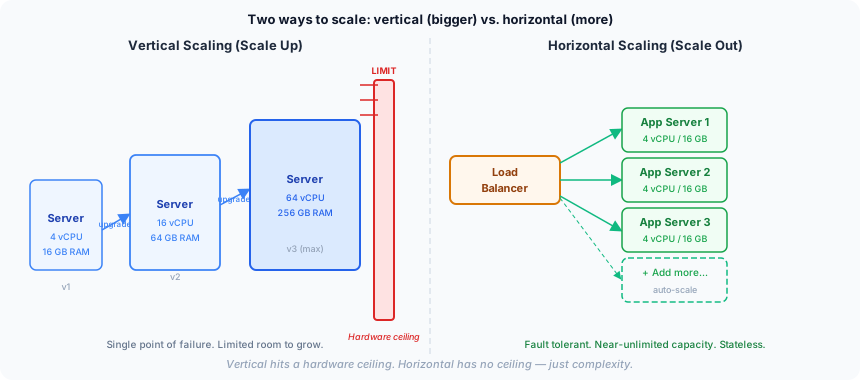
Vertical scaling is often the simplest first step. Horizontal scaling becomes attractive when a component can be replicated safely and the operational cost is justified.
How It Works
There's no single "enable scalability" switch. You scale a system by identifying its bottleneck at each order of magnitude of traffic and applying the right lever. Here's what that looks like in practice:
| Traffic tier | Bottleneck | What you add |
|---|---|---|
| ~100 users | Nothing. Monolith is fine. | Single server. Ship it. |
| ~1,000 users | Single app server CPU | Load balancer + second server. Make sessions stateless (Redis). |
| ~10,000 users | Repeated DB reads | Cache layer (Redis). CDN for static assets. |
| ~100,000 users | DB read throughput | Read replicas. Long jobs go into a queue (Kafka, SQS). |
| ~1,000,000 users | DB write throughput, data volume | DB sharding or managed distributed DB. App tier auto-scales. |
| ~10,000,000 users | Regional latency, global coordination | Multi-region deployment. Global CDN. Eventual consistency. |
The key insight: you may be able to add capacity around the application without rewriting all of its business logic. The right tier depends on the measured bottleneck and the requirements. In an interview, walk through the table and stop at the scale the prompt requires instead of jumping straight to sharding.
The foundational change that unlocks horizontal scaling is making your services stateless. This means the server process itself holds no user-specific data in memory. Any instance can handle any request:
// Bad: session stored in the server process memory
// Only the server that created this session can serve this user
app.use(session({ store: new MemoryStore() }));

// Good: session stored in Redis — any server instance can read it
app.use(session({
  store: new RedisStore({ client: redisClient }),
  secret: process.env.SESSION_SECRET,
  resave: false,
  saveUninitialized: false,
}));
Once your app tier is stateless, a load balancer can send each request to any available instance. You can add instances when traffic spikes and remove them when it drops. When an instance crashes, requests route around it — statelessness is the one prerequisite that unlocks everything else in this section.
Key Components
| Component | Role in Scalability |
|---|---|
| Load Balancer | Distributes requests across app server instances. Enables horizontal scaling. Performs health checks and removes failing instances. |
| CDN | Serves static assets (JS, CSS, images, video) from edge nodes worldwide. Offloads a significant percentage of all bandwidth from your origin servers. |
| Stateless App Tier | Each server handles any request independently. No local session data. Auto-scaling groups can add/remove instances in under 2 minutes. |
| Cache (Redis) | Serves hot reads from memory in under 1 ms. Keeps DB read load flat as traffic grows. Target hit rate above 90%. |
| Message Queue | Absorbs write bursts. Producers push events; consumers process at a controlled rate. Decouples spiky request volume from steady DB write throughput. |
| Read Replicas | Database copies that handle read traffic. Async-replicated from the primary. Buy 2-4x read headroom before you ever need to consider sharding. |
| Database Sharding | Splits data across multiple DB instances by a shard key (e.g., user ID). Removes the per-node data and write-throughput ceiling. Last resort. |
| Auto-Scaling Group | Monitors CPU, latency, or queue depth metrics and adds/removes app server instances automatically. Handles traffic spikes without manual intervention. |
Types / Variations
Vertical vs. Horizontal Scaling
| Vertical (Scale Up) | Horizontal (Scale Out) | |
|---|---|---|
| Mechanism | More CPU/RAM on one machine | More machines |
| Ceiling | Hard hardware limit | Near-unlimited |
| Failure mode | Single point of failure | One instance down, others continue |
| Complexity | Simple — no code changes | Requires stateless design, coordination |
| Best for | Stateful DBs (short-term) | Stateless app tier, caches, queues |
| Cost curve | Steep — large machines cost disproportionately more | Linear — each instance costs the same |
The table above does not choose the architecture for you; it helps identify the constraint. A database that is slow because of repeated reads may need query tuning, caching, or replicas, while a write or storage ceiling may eventually justify sharding. Confirm the constraint before choosing the remedy.
Reactive vs. Predictive Auto-scaling
Most cloud auto-scaling groups are reactive: they watch a metric (CPU, request latency, queue depth) and trigger when it crosses a threshold. The downside is warm-up time — adding a new instance may take time, during which the existing instances absorb the load spike.
Predictive scaling uses historical patterns or forecasting to pre-warm instances before an expected spike. It can help with known traffic events such as product launches or sale events, but scheduled capacity or a manual pre-warm may be simpler.
When you mention auto-scaling in an interview, name the metric you'd use — for example, "CPU above 70%" or "p95 latency over 200ms." The metric should match the bottleneck; "auto-scaling based on load" is too vague to evaluate.
Interview tip: name your metric
When you mention auto-scaling in an interview, say which metric you'd use. For compute-bound services, CPU utilization may fit; for queue consumers, queue depth may fit; for latency-sensitive APIs, p95 request latency may fit. The important point is to tie the metric to the bottleneck.
Geographic Scaling
Single-region architecture breaks when users are globally distributed. A server in us-east-1 adds 200ms of base latency for a user in Tokyo. Here's the order of operations, from least to most drastic:
- CDN for static assets first.
- Read replicas in each region for low-latency reads.
- GeoDNS routing to send each user to the nearest region.
- Multi-region active-active for Tier 1 systems — every region accepts writes, replication runs bi-directionally.
Multi-region active-active means dealing with conflict resolution, network partitions, and clock skew. Consider it only when regional latency, resilience, or locality is a confirmed requirement; many systems do not need to go beyond CDN delivery and regional read capacity.
Database Scaling Deep Dive
The database is often an early serious bottleneck. App servers are usually stateless and relatively easy to add; databases are stateful, so distributing reads and writes requires more care.
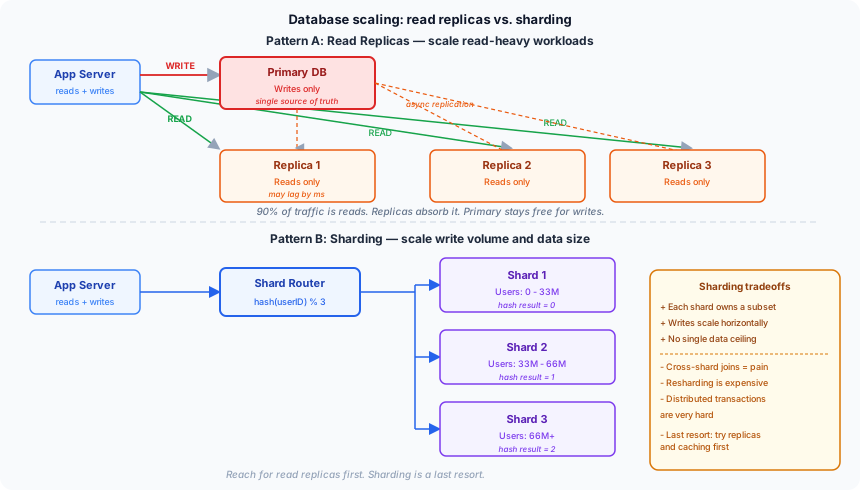
Read replicas work because most applications are heavily read-skewed (often 90%+ reads). You add one or more async-replicated copies of the primary and route all SELECT queries to them. The primary handles only writes.
Read replicas can provide substantial read headroom without changing the schema. They are usually simpler to introduce than sharding, but they do not solve a primary write bottleneck and they introduce replica lag.
Replication lag is real
Read replicas are usually eventually consistent. Changes written to the primary may take milliseconds, or longer under heavy load, to appear on replicas. For reads where freshness matters—such as reading your own writes or confirming a payment—route to the primary or use an explicit read-your-write mechanism.
Sharding splits the dataset itself across multiple independent database instances. Each shard owns a subset of the data (typically partitioned by a hash of the primary key). Cross-shard queries (joining data owned by different shards) are expensive and often require denormalization.
Use sharding when:
- Your dataset is too large to fit on a single machine's storage.
- Your write throughput has outpaced what a single primary can handle.
- You've already exhausted read replicas, caching, and query optimization.
One useful progression is: profile and tune first, cache repeated reads, add read replicas for read throughput, and consider sharding only when the data or write workload exceeds what one primary can handle. The exact order depends on the measured bottleneck; sharding is difficult to undo, so it deserves evidence.
Trade-offs
| Pros | Cons |
|---|---|
| Handles traffic spikes without redesign | Distributed systems are harder to debug and reason about |
| Enables zero-downtime rolling deployments | Stateless mandate requires session infrastructure that must itself be HA |
| Fault tolerant — one instance down, others serve traffic | DB sharding introduces cross-shard query complexity |
| Cost-efficient — scale in when traffic drops | More components mean more potential failure points |
| Each layer scales independently | Eventual consistency means some reads may see stale data |
The fundamental tension here is capacity vs. complexity. Every infrastructure layer can add headroom, but it also adds configuration, failure modes, and operational work. Before adding a layer, ask: "Are we solving a measured problem or preparing for a requirement we can describe?"
The goal is to add enough capacity and resilience for the current requirements, while keeping a clear path to the next tier. Additional complexity should have an identified benefit and an owner.
The premature scaling trap
An architecture sized for a much larger workload can be a liability at 100 users: it may be harder to debug, slower to change, and more expensive to operate. Design for a stated growth target and failure requirement, not an arbitrary order of magnitude.
When to Use It / When to Avoid It
Scaling matters whenever the expected load, data volume, latency target, or availability target can exceed the current design. A useful decision process is to start with the simplest fix and escalate only when measurement or requirements show it is insufficient.
Scale horizontally when:
- Your service is stateless, or can be made stateless with minimal effort.
- You need fault tolerance as well as throughput.
- Traffic is unpredictable or follows spiky patterns (consumer apps, marketing events).
- You're running in a cloud environment with auto-scaling available.
Scale vertically when:
- You have a stateful component with tight consistency requirements (single-primary DB).
- The data or compute lives on a single node and distributing it adds more complexity than it solves.
- It's a short-term fix while you architect the horizontal migration.
Avoid over-engineering when:
- You're under 10,000 concurrent users and a monolith serves everyone fine.
- You haven't profiled and confirmed the bottleneck is compute. Slow queries, N+1 patterns, and missing indexes cause more outages than insufficient server count.
- The team doesn't yet have the operational maturity to run distributed infrastructure reliably.
If you're not sure whether you need to scale, you probably don't yet.
Profile before you scale
Before adding servers, run EXPLAIN ANALYZE on your slow queries. Add the missing index. Fix the N+1. In many cases, a query optimization delivers more headroom than doubling your server count and takes 20 minutes instead of 3 days.
Real-World Examples
Applied patterns
These are illustrative patterns rather than claims about a particular company's current architecture.
- Large media service: A stateless app tier can scale across regions, while a CDN handles static media and an auto-scaling group adds capacity for dynamic requests. The important design question is how state, session data, and media metadata are kept outside individual app processes.
- Growing monolith: A monolith can remain a reasonable starting point. Query tuning, indexes, connection pooling, caching, and read replicas may extend its useful life before a service split or sharding migration is justified.
- Hot presence or activity data: A workload may scale more by changing its storage model than by adding app servers. A write-optimized or horizontally partitioned store can be appropriate for frequently updated presence data, provided the consistency and recovery requirements are explicit.
Profile first — then scale the component that is actually bottlenecked.
How to Explain It in an Interview
In a design interview, the useful signal is not just naming a read replica; it is showing why the component is the bottleneck and what changes after the replica is added. A clear sequence is: name the bottleneck, choose the smallest effective lever, then state the consistency and operational consequences.
30-second answer
“Scalability is the ability to handle more traffic, data, or users by adding resources while keeping useful performance and reliability. I would first identify the bottleneck, then choose the smallest appropriate change: vertical scaling for a stateful component, horizontal scaling for stateless services, caching or replicas for read pressure, and partitioning or queues only when the workload requires them.”
5-minute explanation
Start with the workload: request rate, read/write mix, data size, latency target, and availability target. Then make the app tier stateless so a load balancer can distribute requests across instances. Measure the next bottleneck—often a database, cache, queue, or network—and add one layer at a time. Explain the consequence of each layer: replicas and caches can be stale, queues make work asynchronous, and sharding complicates queries and operations. Close by describing the scaling metric, warm-up behavior, health checks, and what happens when the new component fails.
When to bring it up
For a design question with a large or growing workload, explain the scaling strategy after the core requirements and rough estimates are clear. For example: "I’ll keep the app tier stateless so it can scale horizontally, then use caching for repeated reads; I’ll add replicas or a queue only if the measured bottleneck requires them."
Depth expected at senior and staff level:
- Identify the bottleneck correctly. Is it compute? Read throughput? Write throughput? Data volume? Different answers require different solutions.
- Don't jump to sharding. A reasonable progression is profiling and query tuning, caching repeated reads, read replicas for read throughput, and sharding only when data size or write throughput requires it.
- Know what your auto-scaling metric should be — and why. This varies by workload type.
- Address the warm-up gap: when a new instance starts, it needs time to initialize. What happens to requests during that window?
- Discuss consistency. Once you have replicas or caches, your reads may be stale. Know where that's acceptable and where it isn't.
Common follow-up questions and example answers:
| Interviewer asks | Strong answer |
|---|---|
| "Your app server is at 80% CPU. What do you do?" | "First, confirm it's compute-bound and not a slow query. If it's compute, add a load balancer and a second stateless instance. Move sessions to Redis first so any server can handle any request." |
| "The DB is your bottleneck. What's step one?" | "Measure whether reads, writes, query cost, storage, or connections are limiting us. For repeated reads, I would consider caching; for read throughput, a replica may help; a replica does not remove a primary write bottleneck." |
| "How do you scale a write-heavy service?" | "Queue the writes. Producers push to Kafka or SQS. Consumers write to the DB at a controlled rate. You decouple the incoming request spike from the DB's write throughput." |
| "What metric should the auto-scaling group use?" | "Whatever your actual bottleneck is. CPU for compute-bound services. Queue depth for consumers. p95 request latency for latency-sensitive APIs. There's no universal answer." |
| "How do you design for a 10x traffic spike?" | "Stateless app tier plus auto-scaling. Pre-warm the cache before a known event. Put writes behind a queue. Have a runbook for manually bumping the replica count if the primary shows strain." |
The throughline in a clear answer: name the bottleneck explicitly, choose a proportional remedy, and address the consistency implications of what you add.
Deep Dive: Scenario Walkthroughs
Test Your Understanding
Quick Recap
- Scalability is the ability to handle growing load by adding resources without a redesign. The goal is proportional gains in capacity from proportional additions of resources.
- Vertical scaling (bigger machines) has a hardware ceiling and can leave one large failure domain. Horizontal scaling (more machines) can add capacity for replicable workloads but requires stateless design and coordination.
- Stateless services are the prerequisite for horizontal scaling. Sessions, user context, and ephemeral state must live in an external store like Redis, not in the process itself.
- A database is often an early bottleneck, but measure whether the issue is repeated reads, read throughput, write throughput, storage, or query cost. Add caching, replicas, or sharding only when the measured constraint calls for it.
- Sharding scales write throughput and data volume but introduces cross-shard query complexity and is expensive to undo. Treat it as a last resort.
- Auto-scaling handles traffic spikes automatically, but pick the right metric (CPU, queue depth, latency) and account for the instance warm-up gap.
- In interviews, name the bottleneck explicitly, choose the simplest effective remedy, and address the consistency implications of what you add.
Related Concepts
- Load Balancing — The mechanism that makes horizontal scaling of the app tier actually work. Understanding health checks and routing algorithms is essential.
- Caching — The fastest way to reduce load on your DB without adding any new servers. Cache hit rate determines how much work your database actually has to do.
- Data partitioning — The deep dive on splitting data across multiple database instances, including how to choose a partition key and what resharding costs.
- Databases — Covers the read replica setup in detail, including consistency guarantees, replication lag, and when to route reads to the primary.
- Message Queues — The tool for scaling write-heavy workloads by decoupling producers from consumers and absorbing traffic bursts.
Related Articles
Learn how load balancers distribute traffic across servers, which algorithms to choose, and how to design a highly-available app tier in any system design interview.
Learn how caching eliminates redundant database reads, which strategy to choose for your write pattern, and how to design a cache layer that survives invalidation at scale.
Learn how data partitioning splits rows across nodes for horizontal scalability, when to pick range vs hash vs directory-based strategies, and how to handle hotspots and rebalancing.
Learn how databases organize data for fast retrieval, which storage engine to choose for your workload, and how ACID transactions keep concurrent writes correct at scale.