Caching
Learn how caching eliminates redundant database reads, which strategy to choose for your write pattern, and how to design a cache layer that survives invalidation at scale.
TL;DR
- A cache is a fast storage layer that can answer repeated reads before they reach the database. The cache hit rate is a useful first estimate of how much read traffic remains for the database.
- At a 95% hit rate, the database receives about 5% of cacheable reads—roughly 20× less than without that cache. The actual benefit depends on which requests are cacheable and how the hit rate is measured.
- The core trade-off is freshness vs. latency and cost: a cache stores a copy that may be older than the source of truth. TTLs, invalidation, and versioning bound that staleness.
- Cache-aside is a common default read pattern. Write-through, write-behind, write-around, and explicit invalidation are alternatives chosen for different write and freshness requirements.
- Cache invalidation—deciding when a copy is no longer safe to use—is one of the hardest parts of operating a cache. A stale value can look like a successful response, so the design needs observable freshness and failure behavior.
The Problem It Solves
Imagine an e-commerce platform with 500,000 concurrent users. Suppose 80% of them are looking at the same 100 product pages during a busy sale.
The PostgreSQL database has 12 million products, but those 100 rows are being read roughly 4,000 times per second each. For this illustrative calculation, assume each SELECT takes 5ms: 400,000 reads/second × 5ms implies about 2,000 concurrent units of work if all requests overlap. A connection pool capped at 200 would queue requests rather than process them all at once.
The query time climbs from 5ms to 50ms as connection contention sets in, then to 500ms as the connection pool queue fills. Your monitoring dashboard shows CPU at 95%, I/O wait climbing. At 10:03 a.m. the DB falls over.
The issue is not that the data is complex to retrieve; it is that the same 100 rows are being fetched repeatedly. Read replicas may add read capacity, but they do not remove the repeated work. A cache can reuse the result when the data is sufficiently stable and the staleness policy is acceptable.
The hidden assumption in every 'scale horizontally' recommendation
Adding more app servers doesn't help if every one of them fires a database query for the same popular data. You go from one app server making 400K DB queries/second to 10 app servers making 400K DB queries/second — because the bottleneck was never the app tier. Adding more app servers without a cache layer just means more machines hammering the same database.
The first candidate fix is to answer repeated requests from a faster layer instead of recomputing the same result for every request. Replicas or more app servers may still be useful for other bottlenecks.
What Is It?
A cache is a faster storage layer that sits between an application and its source of truth. It holds copies of recently or frequently accessed data so future requests can be served without reading the source every time.
Analogy: Think of a coffee shop that serves 300 customers a day, and 90% of them order the same three drinks. The barista could grind beans fresh for every single cup. Or, they could brew a large batch of the popular drip coffees at the start of the hour and pour from it.
Most customers get their coffee in 10 seconds instead of 3 minutes. The three popular coffees are the cache. The bean grinder is the database.
The batch brew is the cache population. Stale coffee that's sat for 4 hours is the invalidation problem — at some point, you throw out the old batch and brew a fresh one.
With a 95% hit rate in this illustrative workload, the database handles about 20,000 cacheable reads/second instead of 400,000, plus any writes and non-cacheable queries. Whether that is comfortable depends on the database's actual capacity, but the cache has removed most repeated read work.
Anchor a caching discussion in the hit rate and its consequence: “At a 95% hit rate, this cacheable read path sends about 5% of requests to the database.” That explains the mechanism without treating the ratio as a guarantee for every workload.
How It Works
Here is the request flow for cache-aside, a common default pattern:
- Client sends a request — e.g.,
GET /products/7429. The app server needs product data. - Check the cache first — The app constructs the cache key (
product:7429) and sends a RedisGET. The latency depends on the network and deployment; an in-region cache lookup is often much faster than a database query. - Cache hit → return immediately — If the key exists, deserialize the value and return it. The database is not involved on this path.
- Cache miss → fetch from source — Redis returns
nil. The app queries the database (SELECT * FROM products WHERE id = 7429). - Populate the cache — The app takes the database result, serializes it, and writes it to Redis with
SET product:7429 <data> EX 300(an illustrative 5-minute TTL). Future requests may skip the database until the entry expires or is invalidated. - Return the result — The first caller pays the source latency. Subsequent callers may get the cached value until the TTL expires or the key is invalidated.
async function getProduct(productId: string): Promise<Product> {
  const cacheKey = `product:${productId}`;

  // Step 1: Check cache (usually faster than the source on a hit)
  const cached = await cache.get(cacheKey);
  if (cached !== null) {
    return JSON.parse(cached) as Product; // Cache hit
  }

  // Step 2: Cache miss — fetch from the database
  const product = await db.queryOne<Product>(
    'SELECT id, name, price, description FROM products WHERE id = $1',
    [productId]
  );

  if (!product) throw new NotFoundError(`Product ${productId} not found`);

  // Step 3: Populate cache with an illustrative 5-minute TTL
  // Fire-and-forget is optional; a failed cache write must not hide a
  // successful source read, and the next request can retry population.
  cache.set(cacheKey, JSON.stringify(product), { EX: 300 }).catch(console.error);

  return product; // DB miss latency — only the first caller pays this cost
}
Interview tip: state your hit rate and its consequence
When you add a cache in an interview design, follow it with the expected hit rate and its consequence: “If 95% of these reads hit the cache, the database receives roughly 5% of this cacheable traffic.” State that the number is an estimate to be verified with measurements.
The first caller to request product 1337 after a miss (or after TTL expiry) pays database latency. Other callers may receive the cached value until the entry expires or is invalidated. This asymmetry is useful when reads repeat within the freshness window.
Walking through both paths makes the trade-offs visible: the hit path protects the source, while the miss path determines freshness, stampede behavior, and error handling.
Key Components
| Component | Role |
|---|---|
| Cache key | The string identifier for a cached value. Namespace convention: {resource}:{id} (e.g., product:7429, user:session:abc123). Poorly designed keys collide or cannot be selectively invalidated. |
| TTL (Time-To-Live) | How long a cache entry lives before automatic expiry. It balances freshness (low TTL) against hit rate (high TTL); the right value depends on the data and its staleness tolerance. |
| Eviction policy | When the cache is full, the rule for choosing what to evict. LRU (Least Recently Used) is a common general-purpose choice, but the workload should determine the policy. |
| Hit rate | cache_hits / (cache_hits + cache_misses). The primary health metric for any cache. A declining hit rate is the early warning for a failing cache strategy. |
| Cache cluster | Multiple cache nodes providing replication for availability and, where supported, sharding for capacity or throughput. A single node is a larger failure domain and a capacity ceiling. |
| Serialization format | How values are encoded for storage. JSON is human-readable but slow. MessagePack or protobuf are faster. The choice compounds at high hit rates. |
| Connection pool | A pool of persistent connections from the app to Redis. Creating a new connection per request adds setup overhead and can exhaust connection limits; pooling is usually preferable. |
| Read replica | A Redis replica that can accept reads, offloading throughput from a primary. Use it when the deployment and consistency model support the read pattern. |
Cache Layers
Many production systems use multiple cache layers. Each layer can be closer to the user and faster than the one below it, but usually has smaller capacity and a separate freshness or invalidation policy.
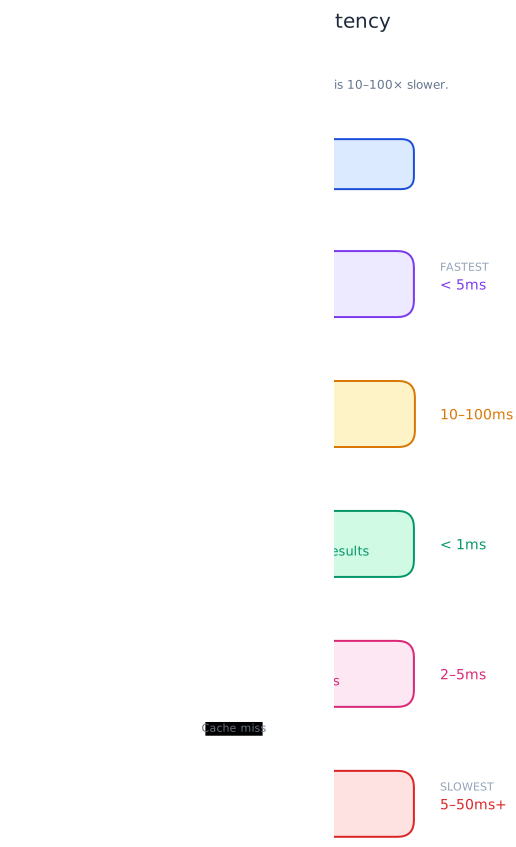
| Layer | Technology | Latency | Who manages it |
|---|---|---|---|
| Browser cache | HTTP cache headers (Cache-Control, ETag) | 0ms (local) | Browser, controlled by your response headers |
| CDN edge cache | Cloudflare, Fastly, Akamai PoP | 5–30ms (nearest PoP) | CDN provider + your purge API |
| Application cache | Redis, Memcached | < 1ms (same network) | You — fully under your control |
| DB buffer pool | Postgres shared_buffers, MySQL InnoDB pool | 2–5ms (in-process) | DB engine, automatically managed |
| Disk / storage | SSD, HDD, object store | 5–50ms+ | You / cloud provider |
The browser and CDN layers are covered in depth in the CDN article. The remainder of this article focuses on the application cache layer — the one you design, own, and debug.
For an interview, three layers are often enough: browser/CDN, application cache, and database. Add latency estimates only as illustrative assumptions, then spend time on the application-layer decisions you actually control.
Read Strategies
How the cache gets populated is a design decision. Cache-aside and read-through are common read patterns; the correct choice depends on who owns the source lookup and how much control the application needs.
Cache-Aside (Lazy Loading)
The application manages the cache directly. On a miss, the app fetches from the database and populates the cache itself. This is the pattern shown in the "How It Works" code above.
Characteristics: Only data that has actually been requested is cached, so cold data does not occupy cache space. The first request to a key usually pays source latency; subsequent requests can use the cache. Staleness is bounded by TTL only if the entry is allowed to expire, and explicit invalidation can shorten that window.
Cache-aside is often a good default because the source lookup and fallback behavior remain explicit in application code.
Cache-aside is a common default for read-heavy systems.
Read-Through
The cache itself is responsible for loading data from the source on a miss. The application talks only to the cache on the read path; the cache's loader queries the source.
Characteristics: Simpler application code — one data access layer handles everything. The cache must be configured with your DB schema and connection, often via libraries like Spring Cache or AWS DAX for DynamoDB. The first-request latency and thundering-herd exposure are identical to cache-aside.
Read-through is most useful when a framework or cache library naturally supports it and the team is comfortable debugging the data-access layer it introduces. Cache-aside can be easier to reason about because the miss path remains visible in the application.
Cache-aside vs. read-through in interviews
The distinction is where the DB query logic lives. Cache-aside: the application populates the cache on a miss. Read-through: the cache populates itself. Both produce identical outcomes. Interviewers mostly care that you can name both and distinguish them — the practical difference is an implementation detail.
Write Strategies
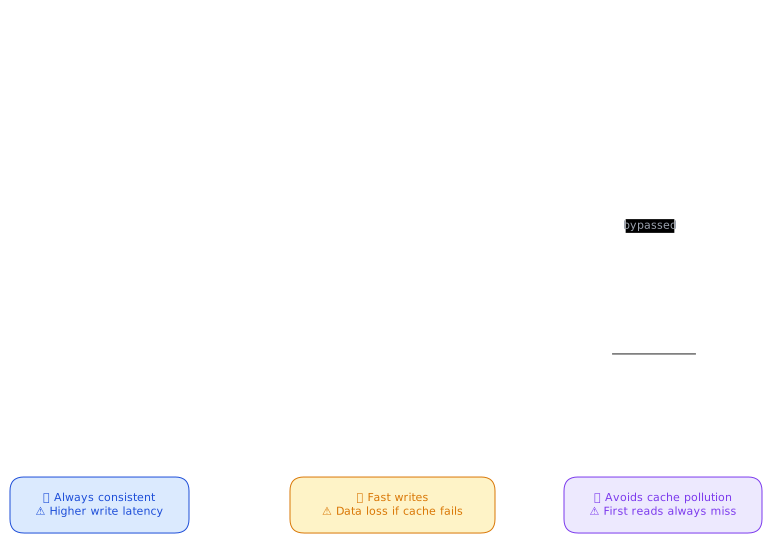
When data changes, what gets updated and in what order? Many caching bugs originate in this write path. Caching is not only a read concern; the design must specify how writes, invalidation, retries, and failures interact.
Write-Through
Data is written to the cache and the database in the same write path. A cache and a database do not provide an automatic cross-system transaction, so the design must state which system is authoritative and what happens if one write fails. Some systems wait for both writes; others acknowledge the durable database write and repair the cache asynchronously.
async function updateProductPrice(productId: string, newPrice: number): Promise<void> {
  // The database is authoritative. The cache is refreshed after the commit;
  // a cache failure should be observable and repaired, but must not make a
  // successful database write look like a failed price update to the caller.
  await db.query('UPDATE products SET price = $1 WHERE id = $2', [newPrice, productId]);
  try {
    await cache.set(`product:${productId}`, JSON.stringify({ price: newPrice }), { EX: 300 });
  } catch (error) {
    metrics.increment('cache_refresh_failed');
    repairQueue.enqueue({ productId, newPrice });
  }
}
Use when: Read-heavy data benefits from a refreshed cache value after a successful write, and the extra write latency and failure handling are acceptable. For inventory or account data, the authoritative database should still decide whether an operation is allowed.
Avoid when: Write-heavy workloads such as analytics events or counters, unless the cache is intentionally part of the write model and its durability is understood.
Write-Behind (Write-Back)
Data is written to the cache first and acknowledged to the caller immediately. The cache flushes changes to the database asynchronously via a background process or queue.
async function recordPageView(articleId: string): Promise<void> {
  // Increment in-memory counter — responds in < 1ms
  await cache.incr(`views:${articleId}`);

  // Enqueue DB flush — batched, happens out-of-band
  await queue.enqueue({ type: 'flush_views', articleId });
  // If the cache node crashes before flush, view counts since last flush are lost
}
Use when: Very high write throughput where a documented loss window is acceptable, such as view counters, click events, or some IoT telemetry. A payment or inventory record should not rely on a cache as its only durable copy.
Avoid when: Data represents money, inventory, or any state that must survive a cache failure without loss.
Write-Around
Data is written directly to the database, bypassing the cache entirely. If a corresponding cache entry exists, it must either be invalidated or be allowed to remain stale until its TTL expires; otherwise readers may see the old value.
async function archiveOldOrder(orderId: string): Promise<void> {
  // Direct DB write — this data is read rarely; caching it wastes memory
  await db.query('UPDATE orders SET archived = true WHERE id = $1', [orderId]);
  // No cache interaction — cache either holds stale data until TTL expires,
  // or this key was never cached in the first place
}
Use when: Data is written once and read rarely, such as archived records, audit logs, or cold historical data. Caching it may consume memory without a useful hit-rate benefit.
Cache Invalidation on Write
One common pattern is: write to the database, then delete the cache key. The next read miss can repopulate from the source of truth.
async function updateUserProfile(userId: string, profile: UserProfile): Promise<void> {
  // 1. Write to source of truth first
  await db.query(
    'UPDATE users SET name = $1, email = $2 WHERE id = $3',
    [profile.name, profile.email, userId]
  );

  // 2. Invalidate the key after the source write succeeds.
  // Updating the cache here can race with another writer; deletion keeps
  // the source of truth responsible for rebuilding the value.
  await cache.del(`user:${userId}`);
}
Treat cache refreshes as a concurrency problem
A common bug is writing to the database and immediately setting a new cache value. Under concurrent load, Write A can update the database, Write B can update it again, then a delayed cache update from A can overwrite B's value. Deleting after a successful source write avoids many stale-write races, but an in-flight read can still repopulate an old value; version checks, leases, or a reliable invalidation event may be needed for stricter guarantees.
For cache-aside, write to the source first and invalidate afterward. Document what happens if invalidation fails, and make the next read safe to retry.
Cache Invalidation
The familiar saying about cache invalidation and naming is memorable because invalidation is difficult to reason about. The practical question is: given that the source has changed, when is the cached copy no longer safe to use?
Invalidation is the question: given that the database has changed, when does the cache know to discard its stale copy?
TTL-Based Invalidation
The simplest approach is a fixed expiry. After the TTL, Redis can evict the key and the next read repopulates it from the current source data.
| TTL range | Behavior | Right for |
|---|---|---|
| Very short (< 30s) | Near-real-time freshness · High miss rate | Data that changes per-second (live scores, stock prices) |
| Medium (1–15 min) | Good hit rate · Acceptable staleness | Product catalog, user profiles, session tokens |
| Long (1–24h) | Excellent hit rate · Risk of stale data | Reference data (country list, config flags) |
| No TTL (persistent) | No self-healing | Keys that are explicitly invalidated on every write |
If the data changes frequently enough for users to notice staleness, TTL alone may be insufficient; event-driven invalidation or a read path with stronger consistency may be needed.
Event-Driven Invalidation
On every write, proactively delete relevant cache keys. When invalidation succeeds, the stale window is roughly the delay between the source write and the invalidation call. If an event is lost or a consumer is down, the old value can remain until another repair or its TTL, so reliable delivery and a fallback policy matter.
A users row change might need to invalidate user:{id}, feed:{id}, profile:{id}, and recommendations:{id}. Missing one dependency allows stale data to persist silently, so the dependency graph should be documented and tested.
Version-Based Invalidation
Embed a version number in the cache key. When data changes, increment the version. Old keys become unreachable and eventually expire.
// Version-stamped key: product:7429:v3
const cacheKey = `product:$\{productId\}:v${product.version}`;

// After an update, the new version key is used; the old key simply expires via TTL
// No explicit invalidation needed — the old key is unreachable from new reads
Elegant for immutable-snapshot use cases. The downside: stale keys linger until TTL — memory overhead grows proportional to how often data is updated.
Invalidation is the part of caching that will bite you in production — TTL, events, or versioning, you need a strategy before you ship.
Eviction Policies
When Redis runs out of memory, the eviction policy determines which keys are dropped to accommodate new writes.
| Policy | How it works | Suitable use | Pitfall |
|---|---|---|---|
| noeviction (a common default) | Refuse new writes when full — returns an error | When eviction is unacceptable and callers handle write failures | Write errors can cascade to source overload if not caught |
| allkeys-lru | Evict the least recently used key from all keys | General-purpose caches — automatic cold-data cleanup | Can evict infrequently accessed but expensive-to-recompute keys |
| volatile-lru | LRU only among keys with a TTL set | Shared Redis instances mixing persistent and cached data | Keys without TTL are never evicted — grow unbounded |
| allkeys-lfu | Evict the least frequently used key | Stable hot-key patterns (Zipfian distribution) | Needs a warm-up period; early access skews the frequency count |
| volatile-ttl | Evict the key with the shortest remaining TTL | Preserving long-lived data over short-lived data | May evict keys with seconds left, causing spurious misses |
Interview tip: name the eviction policy
For a general-purpose application cache, a reasonable example is maxmemory-policy allkeys-lru, so Redis evicts less-recently-used keys when memory fills. State that it is a choice for this workload, and mention what should happen when an eviction or cache failure is not acceptable.
Trade-offs
| Pros | Cons |
|---|---|
| Dramatic read latency reduction — 5–50ms DB reads become < 1ms cache reads | Cache miss paths add code complexity — miss and populate logic must be correct |
| Shields the database from read fan-out — prevents DB overload at scale | Consistency is eventually (not immediately) guaranteed — stale reads are an inherent property |
| Cost efficient: RAM is cheap; DB instances that scale to millions of QPS are not | Cache coherency bugs are silent — no exception fires when you serve a stale value |
| Enables horizontal read scaling — Redis cluster handles millions of ops/sec cheaply | Thundering herd on popular key expiry can spike DB load above its capacity ceiling |
| Sessions, rate limit counters, leaderboards, and pub/sub land naturally on an in-memory store | Redis is a new SPOF — failure must be handled gracefully (fall through to DB + circuit breaker) |
| Absorbs hot-key read traffic that no single DB shard could sustain | Debugging cache coherency issues requires correlating cache state and DB state across time |
The fundamental tension here is freshness vs. performance and cost. A cache is a copy of the source that may be stale. The performance gain comes from reusing that copy, so the design must say how much staleness is acceptable.
The engineering challenge is deciding how stale is acceptable for each type of data — and building the invalidation mechanics that enforce that bound. Get the staleness tolerance wrong and your users will notice.
When to Use It / When to Avoid It
Caching is most useful when the same data is read repeatedly, the source lookup is expensive enough to matter, and a bounded amount of staleness is acceptable. The full decision depends on the read/write mix and failure behavior.
Use caching when:
- Your read traffic is much higher than your write traffic for a given dataset.
- The same data is read repeatedly within a window shorter than your acceptable staleness window.
- Database query response time is a meaningful fraction of total request latency.
- You need to scale reads past what a single primary or read replica can handle.
- You store derived or computed values that are expensive to recompute (aggregations, rendered templates, ML inference results).
Avoid caching (or be very careful) when:
- Data is write-heavy and read-once — audit logs, financial ledger entries. Cache pollution with zero hit benefit.
- Data must be visible to every reader immediately after a write—for example, a payment acknowledgement or inventory decision. TTL-based caching is not sufficient by itself; use explicit invalidation or a strongly consistent read path.
- You're prototyping. Cache adds complexity that masks performance problems. Measure DB performance first, then cache proven bottlenecks.
- Cache failure would cause silently incorrect behavior. If your app serves wrong inventory or wrong prices when the cache breaks, verify your invalidation logic is complete before deploying.
If an application serves the same read-heavy data to many concurrent users, caching may reduce source pressure substantially. It is still a measured design choice: a cache adds memory, invalidation, observability, and failure handling.
Cache vs. read replica — different tools for different problems
A database read replica reduces write pressure on your primary and provides a standby for failover. Queries still take milliseconds; connection pool limits still apply. A cache is an in-memory key-value store — lookups take microseconds with no connection-pool concern. Use read replicas for complex queries, analytics, and reducing primary write pressure. Use caching for hot-path reads that are the same query repeated thousands of times per second.
The Thundering Herd Problem
One important cache failure mode occurs when a TTL expires on a popular key. It is called a thundering herd because many requests miss together and repeat the same source lookup.
The scenario: Your most popular product (product:viral-item) is cached with a 60-second TTL. At 09:00:00.000, the key expires. Within the next 50ms, 1,000 requests arrive for that product — every single one gets a cache miss.
Every single one fires a database query simultaneously. Your database spikes from 50 queries/second to 1,050 queries/second in 50ms. If your DB connection pool has 100 connections, 900 queries queue immediately.
Latency climbs. Cache population slows. The spike persists until repopulation finishes — which takes longer because the DB is already overloaded.
For a high-traffic key, an uncoordinated expiry can create a database spike. The size of that spike depends on request concurrency, source capacity, and how quickly the value can be repopulated.
Fixing the Thundering Herd
Option 1: Mutex lock — Only the first requester that observes a miss acquires a lock and fetches from DB. All others wait, then return the populated value.
function getWithMutex(key, fetchFn):
  cached = cache.get(key)
  if cached exists → return cached

  lockKey = "lock:" + key
  acquired = cache.set(lockKey, "1", NX=true, EX=10)
  // NX = "set only if key does not exist" — atomically claims the lock

  if acquired:
    try:
      value = fetchFn()             // only this one request hits the database
      cache.set(key, value, EX=300)
      return value
    finally:
      cache.del(lockKey)            // always release the lock, even on error

  // Another process is already fetching — wait and retry
  sleep(50ms)
  return getWithMutex(key, fetchFn) // lock is gone; value should be in cache now
Option 2: Probabilistic Early Expiration (PER) — Before TTL fully expires, randomly refresh the cache with probability rising as expiry approaches. No lock contention; stale data is briefly served while the background refreshes.
function getWithEarlyExpiration(key, ttl, fetchFn):
  value     = cache.get(key)
  remaining = cache.ttl(key)

  if value is null → return null   // complete miss — caller handles fallback

  // Randomly trigger a background refresh before the key fully expires.
  // Probability rises as remaining TTL shrinks toward zero.
  threshold = ttl × 0.20           // begin considering refresh at 20% TTL left
  if remaining < threshold AND random() < 1.5 × (1 - remaining / threshold):
    background: cache.set(key, fetchFn(), EX=ttl)  // async — does not block caller

  return value   // always return current cached value immediately
Option 3: TTL jitter — Instead of a fixed TTL across a batch of keys, add random variance at population time. Expiry events spread out across a window instead of firing simultaneously.
const BASE_TTL = 300;
const JITTER = 60; // ± 1 minute

const ttl = BASE_TTL + Math.floor(Math.random() * JITTER * 2) - JITTER;
await cache.set(cacheKey, value, { EX: ttl }); // TTL between 240–360 seconds
TTL jitter is inexpensive to implement and reduces synchronized expiry without lock contention. It is a useful option for batches of keys populated together, but it does not replace capacity limits or request coordination.
Applied Patterns
The patterns below are deliberately generic. They show how caching decisions fit a workload without making claims about a particular company's current implementation.
Two-level cache for a social feed
A social-feed service can use an in-process L1 cache for the hottest content and a distributed L2 cache such as Memcached or Redis for shared data. L1 avoids the network round trip for the most popular items; L2 lets different app instances share a larger working set. A feed can use fan-out-on-write for ordinary accounts, while a very high-fan-out account uses a pull path or a short-lived hot-post cache instead of writing to every follower's feed synchronously.
This illustrates that caching can be part of the read model and feed architecture, not just a small optimization around one database query. The design still needs a recovery plan and a freshness bound.
Lease-based cache fill
In a large distributed cache, a miss can be given a lease or request token to coordinate the first refill. If a concurrent write invalidates the key while the lease holder is reading from the source, the lease can be revoked and the reader must verify freshness before publishing the value. This reduces the chance that a slow read repopulates an older value after an invalidation.
Pre-warmed page cache
A page-heavy site can combine an in-process MemoryCache with a shared L2 cache and refresh popular values in background jobs before their TTL expires. That keeps user traffic away from the database for the hottest pages, while the database remains the source of truth and the refresh job remains observable.
The common lesson is that caching eventually becomes a consistency and invalidation problem as much as a latency problem.
How to Explain It in an Interview
The useful signal is not just naming Redis. Explain what data is cacheable, what hit rate you expect, how much staleness is acceptable, and what happens on a miss or cache failure.
30-second answer
“A cache stores frequently reused data closer to the request path so repeated reads do not reach the source every time. I would choose a cache key and TTL, measure hit rate and latency, define invalidation on writes, and decide whether stale data is acceptable. Cache-aside is a common default, but the source of truth and failure path must remain clear.”
5-minute explanation
Start with the read pattern and a rough estimate: how often the same data is requested, how expensive the source query is, and how much staleness the product allows. Show the cache-aside hit and miss paths, then choose a key namespace, serialization format, TTL, eviction policy, and invalidation strategy. Explain write-through, write-behind, or write-around only if the write workload needs them. Close with cache failure, thundering-herd protection, observability, and whether the system can degrade to the source without overwhelming it.
When to bring it up proactively
Bring up a cache when the design has repeated, expensive, or read-heavy access. Say what you are caching and quantify the effect as an assumption: “If 95% of these reads hit the cache, the database receives about 5% of this cacheable traffic.” Do not draw the box without naming the TTL and invalidation behavior.
Don't just draw the cache — defend your choices
Saying "we'd add Redis here" without explaining what you're caching, your expected hit rate, your TTL rationale, or how you handle invalidation signals a memorised pattern without real understanding. One follow-up question exposes it. State the key space, the TTL, and the invalidation strategy in the same sentence as the cache.
For a deeper discussion:
- Name your cache hit rate and calculate the DB impact: "95% hit rate → DB sees 5% of reads → 20× less traffic — that's the difference between needing 5 read replicas and needing none."
- Explain the write strategy choice. Write-through can suit data that benefits from a refreshed cache; write-behind can suit high-throughput counters with a documented loss window; explicit invalidation should account for concurrent readers and failed events.
- Know the thundering herd problem and two mitigations: mutex lock (serialize misses) or probabilistic early expiration (background refresh before TTL expires).
- Address the cache as a failure domain: replication or managed high availability, plus a graceful degradation path such as bounded fallback to the database with a circuit breaker.
- Distinguish eviction policy (Redis choosing what to drop when full) from invalidation strategy (you proactively evicting stale data after a write). These are separate mechanisms that work together.
Common follow-up questions and example answers:
| Interviewer asks | Strong answer |
|---|---|
| "What's your cache hit rate and how does it affect DB load?" | "If the hit rate is 95% for this cacheable path, about 5% of those reads reach the database. I would measure the rate by key class and alert when it drops enough to threaten source capacity." |
| "How do you handle cache invalidation?" | "Write the source of truth first, then invalidate dependent keys or publish a reliable event. For stricter ordering, add version checks or a lease so an in-flight old read cannot repopulate newer data." |
| "What happens when Redis goes down?" | "Use a circuit breaker and bounded fallback so the database is not flooded by every cache miss. Accept higher latency or a stale/limited response when that is safer than an unbounded fallback." |
| "How do you prevent thundering herd?" | "Coordinate cache misses with a mutex/request coalescing, refresh before expiry, or add TTL jitter. The choice depends on whether the path may serve stale data and how much lock contention is acceptable." |
| "How would you cache a social media feed?" | "Fan-out-on-write: when a user posts, synchronously write into the cached feeds of their followers at write time. Reads are pure cache hits. The trade-off: expensive writes for users with large follower counts. For celebrity users with 50M followers, skip fan-out and let followers pull on-demand with a short TTL — the hot-path latency delta is acceptable." |
Know these cold — cache invalidation, thundering herd, and Redis SPOF handling come up in nearly every system design interview at the senior level.
Deep Dive: Scenario Walkthroughs
Test Your Understanding
Quick Recap
- A cache is a fast storage layer that can answer repeated reads before they reach the source. Hit rate, request mix, and source capacity together determine the benefit.
- In cache-aside, the application checks the cache first, falls back to the source on a miss, and populates the cache on return. Write-through keeps cache and source updates coordinated; write-behind improves write latency only when its durability window is acceptable.
- A TTL is useful for self-healing, but not every entry needs the same expiry policy; some values are explicitly invalidated. Short TTLs improve freshness at the cost of hit rate, while long TTLs improve reuse but risk stale data. Jitter TTL values across hot batches to reduce an avalanche.
- For cache-aside, a common default is to write the source first and invalidate the key afterward. Directly refreshing a value can race with concurrent writers; stricter ordering may require versions, leases, or reliable events.
- A thundering herd occurs when many requests miss a popular key together. A mutex can serialize the refill, while early refresh or TTL jitter can reduce synchronized misses when serving a slightly older value is acceptable.
- A cache is a potential failure domain. Use the deployment's replication or clustering options where appropriate, and build a graceful degradation path that does not flood the source.
- In an interview, state the expected hit rate and calculate its effect on the cacheable read path, then explain TTL, invalidation, miss coordination, and cache failure.
Related Concepts
- Load balancing — Load balancers route traffic across app servers; caches reduce the database traffic those app servers generate. They solve different bottlenecks and may be used together.
- CDN — A CDN is a geographically distributed cache for static and edge-cacheable content. Understanding browser cache headers and CDN invalidation is the natural extension of application-layer caching concepts.
- Databases — Caching exists to protect databases from read fan-out. Understanding database connection pooling, query cost, and replica lag helps calibrate the right TTL and hit-rate targets for any caching strategy.
- Replication — Database read replicas and Redis replication are two different answers to the same read-throughput problem. Read replicas suit complex queries; caches suit repeated simple reads. Knowing when to use each prevents over-engineering.
- Rate limiting — Redis is the canonical store for distributed rate limit counters. The atomic INCR and Lua scripting patterns from this article apply directly to building correct, race-condition-free rate limiters.
Related Articles
Learn how load balancers distribute traffic across servers, which algorithms to choose, and how to design a highly-available app tier in any system design interview.
Learn how a CDN routes users to an edge server, can reduce latency and origin load, and how to choose caching and invalidation policies.
Learn how databases organize data for fast retrieval, which storage engine to choose for your workload, and how ACID transactions keep concurrent writes correct at scale.
Master how database replication scales reads, survives failures, and trades off consistency for availability. Learn replica lag, read stale data purposefully, and why your most critical business logic must run on the primary.